Author: San Diego County Bar Association

Pitch Tips: How to successfully pitch your stories to the press

By Karen Korr and Lyle Moran

Nowadays, social media gives you myriad ways to connect to the press and find reporters who may be interested in your story, your client, or even your law firm partner who has a story that should be in the spotlight. However, public relations professionals and reporters alike will tell you that there are right and wrong ways to get your story seen.  At a recent lunch and learn session at the Bar Center, legal reporter Lyle Moran (formerly with the Los Angeles Daily Journal) and SDCBA Director of Communications and Outreach Strategy Karen Korr shared their top tips for successfully pitching your stories to the press. Read More

Whoops! The New Rules, Law Firms and Cyberattacks

By Edward McIntyre

Macbeth, Duncan and Sara were enjoying a celebratory toast at the Red Coach & Horses when MacTavish, drink in hand, joined them.

“Have you guys seen the news about that major law firm. Had its computer network hacked? Massive embarrassment, for sure.”

Duncan nodded. “I understand the FBI divides law firms into two kinds. Those that’ve been hacked — and those that will be.”

MacTavish laughed and sipped his scotch.

Macbeth cautioned, “Not sure I find much mirth in their misfortune. Not only embarrassing. They have to confront a myriad of liability issues. And think of the ethics nightmare.”

MacTavish looked surprised. “Ethics? How so?”

“Have you looked at the new and revised Rules of Professional Conduct? The ones that just became effective on November 1?”

“Not yet. On my to-do list. But —”

“When you get around to it, take a hard look, for example, at rule 5.1. It’s new in California. We’ve never had anything like it before.”

“What’s it about?”

“It imposes on lawyers with law firm management authority the obligation to ensure that the firm has in effect measures that give reasonable assurance that all the firm’s lawyers comply with the rules. And with State Bar Act.”

“Seems like a bit of an overreach, but —”

“It also requires lawyers with supervisor authority over another lawyer to make sure that lawyer does the same. Rule 5.3 applies the same obligations to the supervision of non-lawyer personnel, whether employees or not.”

“But what’s all that got to do with a computer hack?”

“I assume we agree that, as lawyers, we possess a vast trove of sensitive and confidential client information. Financial data. Transaction and litigation strategies. Personal information. Perhaps health histories.”

“Sure. Necessary to the practice.”

“Rule 1.6 and 6068(e)(1) require us to hold client confidential information inviolate. At almost any cost.”

“New number, huh. OK, understand that.”

“Further, rule 1.1 requires competence, including — in this digital era — staying knowledgeable about the benefits and risks associated with technology.”

“Well —”

Macbeth held up his hand. “Finally, rule 1.4 requires lawyers keep clients reasonably informed about significant developments related to the representation.”

“All fine. But I was talking about a computer hack —”

Sara smiled as Macbeth nodded to a waiter for another round for the table.

“We were indeed. Let’s start with rules 5.1 and 5.3 — even before any computer breach occurs.”

“If you want.”

“Given the prevalence of cyberattacks, likely firm managers and supervisors have an ethical obligation to ensure the firm has adequate cyber protection already in place —current and updated — to prevent the loss of any client information that rule 1.6 requires the firm’s lawyers keep confidential.”

“Good thing I’m a sole practitioner —”

“A manager of your own firm, in other words.”

“Ouch.”
Read More

It’s a Small, Small World: GDPR — not just for EU lawyers

By Edward McIntyre

Macbeth and Duncan were returning from court when Clyde Tabbit caught up with them.

“Macbeth, got a question. Got a minute?”

“Here’s our building. Let’s go up to the office.”

“Really shouldn’t take long. Just a quick ‘yes’ or ‘no’ —”

“You never know, Clyde. Come, join us.”

When the trio were seated in Macbeth’s conference room, Sara joined them.

“Now we’re all here. OK, Clyde, what’s the quick question?”

“Well, I keep getting strange requests from a couple of clients.”

“Proceed.”

“So, I represent a guy who moved to Italy years ago. Permanently. But still has a business here. As well as in Italy and other places.”

“We get the picture. What’s the issue?”

“Well, he keeps making these flaky demands on me to identify all the information I’m ‘storing’ — Clyde used air quotes — on him. On his companies. Getting more and more insistent. I’ve blown him off. But he won’t stop.”

“Let me see if I understand. He resides in Italy. A citizen there?”

“Yep, dual. Some family connection.”

“You provide legal services to him?”

“Of course. He’s my client. Both him and his businesses. There and here. Why?”

“Have you noticed all the ‘privacy updates’ you’ve been getting recently? From social media sites and other internet providers?”

“Come to think of it, yeah. Keep getting one from CNN about terms of service and privacy and stuff. Annoying. Even from some law firms. Can’t figure why.”

“Likely GDPR compliance. I suspect that’s what’s triggered your Italian client’s requests.”

“GDPR?”

Macbeth nodded to Sara.

“The General Data Protection Regulation. Enacted in 2016, but effective May 25, 2018. The GDPR’s purpose is to provide a uniform law governing the protection of personal data across the European Economic Area. That’s the EU plus three other European countries. It replaces the individual national laws passed under the 1995 Data Protection Directive. The GDPR is intended, among other things, to clarify, strengthen and modernize data protection. Especially in light of the changes in how companies collect and process personal information.”

“So what. I’m not in Europe.”

“You provide services to a European citizen, living there. Some of the services related to his businesses there. Does he pay you in euros or dollars?”

“Euros. Conversion costs me money every time. But I’m here, not there.”

Sara continued. “The GDPR applies to any organization collecting or processing anyone’s personal information. Think ‘personal data.’ If that collection or processing is done in relation to activities of the organization established in the EU. No matter where the collection or processing takes place.”

“See, I’m not an ‘organization established in the EU’ — more air quotes. Doesn’t apply.”

“I understand your point. But if a U.S. firm offers services to EU residents, then the firm is subject to the GDPR. It’s a fact-based analysis whether a company is offering services to EU residents, but services payable in euros likely would be.”

“Ouch. Does that include my clients in France and Sweden, as well?”

“France is part of the EU; Sweden, joined the EEA. So, yes.”

“What does all this mean?”

“Essentially, it requires greater transparency by those who collect or process data to the owners of the data — among a lot of other things. Very stiff penalties for non-compliance.”

Clyde looked to Macbeth. “What does this mean for me?”

“From a professional responsibility viewpoint, two things come immediately to mind.”

“OK —”

“First, you have an ethical obligation under Rule 3-500 to respond to reasonable client inquiries. Given the effective date of GDPR and your transparency obligations, you have a duty to respond to your client’s questions.”

“All of them?”

“I’ll let Sara spend time with you about the GDPR requirements. She’s our expert. Ethically, the requirement is to keep the client ‘reasonably informed’ about significant developments in the representation. I think a change in law this significant to a client’s rights would be considered a ‘significant development.’”

“Other advice?”

“But be sure to remind your client that you, as a lawyer, are duty-bound — new Rule 1.6, former Rule 3-100, and section 6068(e)(1) — to keep all the client’s information confidential. ‘At every peril to yourself.’ You don’t share it. That should address some of the client’s legitimate data privacy concerns.”

“Good idea. Anything else?”

“Our duty of competence requires us to have or acquire the requisite skill and learning, or consult with a competent lawyer who has them, when representing a client. A COPRAC formal ethics opinion, and amendments to two ABA Model Rules, suggest the duty of competence applies to knowledge about technology. I think a lawyer representing clients in Europe has a duty to understand those clients’ GDPR rights. And the lawyer’s GDPR obligation toward those clients.”

“Even if we practice in the United States?”

“A small world just got a lot smaller, my friend. Spend some time with Sara in the conference room. She’ll walk you through all the new GDPR data privacy requirements, including the right to ‘be forgotten’ and what that might mean to our duty to former clients and conflicts, and such.”

“Wow!”

“Wow it is, my friend.”

Macbeth and Duncan started to leave, Macbeth humming the tune from “It’s a Small, Small World.”

Editor’s Note: The COPRAC opinion to which Macbeth referred is Formal Opinion 2010-179.

See also comments to ABA Model Rules 1.1 and 1.6, competence and confidentiality. New and revised Rules of Professional Conduct become effective November 1, 2018.
Read More


Be the Best You

By Joan R. M. Bullock

In the March/April issue I wrote the article, “Today’s Lawyer,” focusing on the solo and small firm practitioner. I noted how the DIY economy, fueled by commoditization of legal solutions from digital platforms, threatens the practices of solo and small firm lawyers. A similar commoditization — developing reusable templates for bread-and-butter legal work — functioned well for the small firm practitioner. The practitioner profited from being able to charge a reasonable fee based upon the value of the legal solution proffered even though the actual time taken to provide the legal solution was shortened through the repeated use of the template. In fact, the small firm practitioner could expand the practice by utilizing interns, new lawyers and paralegals to complete and review the template for client matters with a resultant growth in revenue and profits for the firm’s bottom line. Digital platforms such as LegalZoom, Rocket Lawyer, Nolo, LawDepot and even the Google search engine, however, took this commoditization of legal solutions one step further—making a form of the template accessible to the lay market, permitting these platforms to profit from the volume of those seeking access as well as from the subsequent queries that come from the lay market utilizing those templates.

The increasing competitive nature of small firm practice and the growing encroachment of digital platforms in the legal services market have resulted in seasoned practices being reluctant to bring on novice attorneys who cannot contribute to the bottom line early on. Law schools have stepped up to this challenge and are providing more skills and experiential training in the curriculum. But is this enough?

About a month ago I got an update on LinkedIn regarding an article entitled “How a Thomas Jefferson Grad Came to be in Charge of the Ivy League Alums.” The author, Frederick Shelton, President and CEO of the Legal Business & Marketing Consulting firm of Shelton & Steele, wrote about the “Rainmaker’s Reward” and the utility of street smarts. It’s no secret that those who are able to make it rain are prized in a firm. Lawyers who can bring in new business are highly valued, even if they do little of the work that they bring in and even if they give little face time in the office. They add directly to the firm’s bottom line and therefore are given deference. This deference extends to how much time they need to spend in the office and how much client work they need do. Rainmakers have options. A firm not willing to give this deference will soon find that the revenue generated by the rainmakers will leave with those rainmakers to more accommodating firms. This is the “Rainmaker’s Reward” and it is control over the lawyer’s professional destiny and personal life.

Many lawyers, however, are uncomfortable seeing themselves as rainmakers. It looks too much like selling. They’d rather do the work. After all, that’s what law practice is all about. Unfortunately, those who do the work can be easily replaced—by smarter lawyers, less expensive lawyers or other professionals, or even technology. For example, even in the “olden days” tax law was complicated, with many tax returns completed by lawyers. Over the years, tax lawyers lost tax return clients to accounting firms; accounting firms lost many of these clients to volume-based businesses like H&R Block; volume-based businesses lost clients to software companies that catered directly to individual taxpayers. Now, for the simplest returns, the IRS allows individual taxpayers to complete their return from the IRS website without having to purchase the software. The now pervasive use of technology to assist in completing the tax return has converted a manual, calculator with pencil-and-paper approach by a professional, to a gathering of documents, fill-in-the-box approach by the consumer. Taxpayers’ ease in utilizing technology, coupled with software that replaces the judgment of a professional in determining the significance of the taxpayers’ information has, to a large extent, demystified the tax return process.

With more of the lawyer’s work being replaced by technology, it is critical that the lawyer develop a level of street smarts along with embracing the skills of a rainmaker. The sitting at the desk waiting for a prospective client or a supervising attorney to ring your phone or stop by your office and provide you with work is no longer a viable option. Street smarts is the creative edge needed to see and exploit gaps for competitive entry and differentiation. In this regard, the successful lawyer creates his or her own path for job security. A great example of this is TJSL alumna Candace Moon, who was profiled in the June 2018 issue of the ABA Journal. She created her entry into the practice of law by discerning and exploiting the gap in the craft beer industry.

Ultimately, lawyers want to have a sense of fulfillment, to believe that they are making a meaningful difference in the world and impacting their clients in a positive way. This can only happen if first, lawyers have control over their personal and professional lives. Accordingly, teaching law students today must include life skill lessons. We’ve heard it before: “In the event of loss of cabin pressure … place the oxygen mask on yourself first before assisting others.” Life happens to everyone. Lawyers take care of and counsel others best when they are in a good place by having first taken care of themselves. Be the best you for your clients and your firm. Take care of yourself — first. Read More

Hiring Trends: What Firms Need to Know

By Henry Angelino

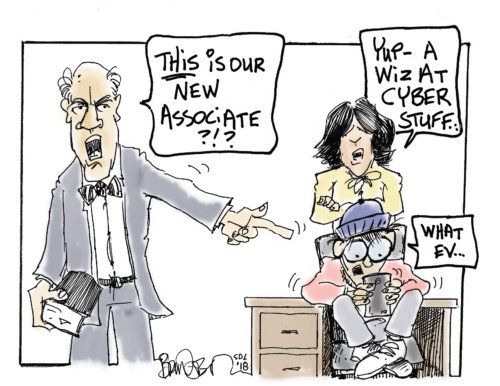
2018 is coming to a close and many firm leaders are thinking about their plans and goals for 2019. One typical consideration is whether to expand their firm by hiring additional staff and/or attorneys. Do they need an assistant or an associate just to keep up with their case load, and can the budget support another salary? If this is their first employee, they have the added concern of ensuring the structure and procedures are in place to properly manage and efficiently/effectively utilize an employee. Thus, careful planning and research should be part of this major decision, and hiring a new employee should not be taken lightly or done in haste.

So, you think you are ready to move forward and expand your team but aren’t sure of the best path to take in finding a quality candidate. The first step is to make sure you have a complete description of the knowledge/experience requirements, duties and responsibilities for the position, and know the traits you are looking for in your ideal candidate. Additionally, what are your expectations if the position is for a billing professional? Are you looking for a more experienced employee or do you want a less experienced employee that you can train without having to worry about “bad habits” or “knowledge gaps” from previous employers? Do you want to conduct the search or hire a recruiter to do the initial search and screening for you? OK, you have done your homework and are ready to initiate a search. What do you need to know about the current legal hiring market to increase your chance of success? Here are a few trends that I am seeing in San Diego.

-There is an increasing number of smaller and mid-sized firms that are growing and looking for qualified candidates to fill attorney and staff positions. Some of the fastest growing firms are groups of attorneys that have left larger firms to create their own firm and culture.

-There are fewer associate attorneys available due to lower numbers of law students in recent years and it is harder to find associates with three to five years of substantial law firm experience, a typically desired attribute. On the positive side, there is an increasing number of diverse candidates applying for positions.

-Qualified candidates with a solid performance record are in high demand and will usually be exploring multiple opportunities simultaneously. Thus, employers must be ready to move quickly to evaluate quality candidates and make a hiring decision.

-Small to mid-sized law firms are using contract attorneys or part-time support staff personnel to assist with excess legal and administrative tasks. This allows the firm to “test drive” employees before making a permanent hire while remaining within their budget. Another trend is to outsource various human resource and administrative tasks to reduce the time spent to manage the firm and remain compliant with the changing laws and regulations.

-Support staff are more highly qualified and willing to perform multiple roles within small and mid-sized law firms. Many candidates have a paralegal certificate and thus can generate revenue to help offset their salary and benefit costs. Additionally, some more experienced support staff candidates are applying for traditionally entry-level positions and bringing their considerable breadth of skills and experience to smaller firms. Alternately, you will receive a very large number of applications for entry-level positions and will need to separate qualified from unqualified candidates, which can be time-consuming.

-Turnover rates are increasing, causing firm leadership to spend more time hiring and training new employees after a dismissal or departure. Some of the reasons I have seen for this trend is a disparity in values or priorities, employees not meeting stated expectations, and employees not investing the time and effort to build sound legal skills and produce quality work.

Adding new members or service providers to a small or mid-sized law firm team can improve employee and client care, increase productivity, and reduce the time required by leadership to manage the firm while freeing up partners for strategic initiatives, business development and training/mentoring employees. To be successful though, firm management must ensure they carefully and quickly screen qualified candidates to ensure the right cultural and capability fit. Not always an easy task given the current hiring environment!

Henry Angelino is the owner of Angelino & Associates, Inc. and a strategic business and operations consultant for law firms. Read More