Tagged: Legal Ethics

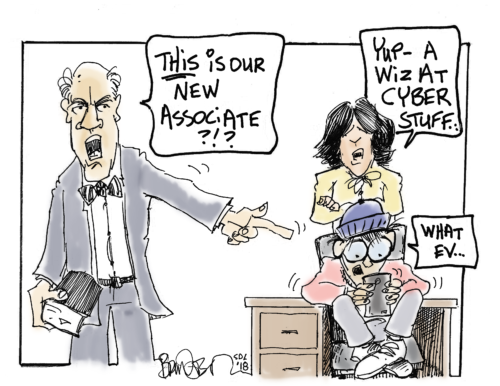
Whoops! The New Rules, Law Firms and Cyberattacks

By Edward McIntyre

Macbeth, Duncan and Sara were enjoying a celebratory toast at the Red Coach & Horses when MacTavish, drink in hand, joined them.

“Have you guys seen the news about that major law firm. Had its computer network hacked? Massive embarrassment, for sure.”

Duncan nodded. “I understand the FBI divides law firms into two kinds. Those that’ve been hacked — and those that will be.”

MacTavish laughed and sipped his scotch.

Macbeth cautioned, “Not sure I find much mirth in their misfortune. Not only embarrassing. They have to confront a myriad of liability issues. And think of the ethics nightmare.”

MacTavish looked surprised. “Ethics? How so?”

“Have you looked at the new and revised Rules of Professional Conduct? The ones that just became effective on November 1?”

“Not yet. On my to-do list. But —”

“When you get around to it, take a hard look, for example, at rule 5.1. It’s new in California. We’ve never had anything like it before.”

“What’s it about?”

“It imposes on lawyers with law firm management authority the obligation to ensure that the firm has in effect measures that give reasonable assurance that all the firm’s lawyers comply with the rules. And with State Bar Act.”

“Seems like a bit of an overreach, but —”

“It also requires lawyers with supervisor authority over another lawyer to make sure that lawyer does the same. Rule 5.3 applies the same obligations to the supervision of non-lawyer personnel, whether employees or not.”

“But what’s all that got to do with a computer hack?”

“I assume we agree that, as lawyers, we possess a vast trove of sensitive and confidential client information. Financial data. Transaction and litigation strategies. Personal information. Perhaps health histories.”

“Sure. Necessary to the practice.”

“Rule 1.6 and 6068(e)(1) require us to hold client confidential information inviolate. At almost any cost.”

“New number, huh. OK, understand that.”

“Further, rule 1.1 requires competence, including — in this digital era — staying knowledgeable about the benefits and risks associated with technology.”

“Well —”

Macbeth held up his hand. “Finally, rule 1.4 requires lawyers keep clients reasonably informed about significant developments related to the representation.”

“All fine. But I was talking about a computer hack —”

Sara smiled as Macbeth nodded to a waiter for another round for the table.

“We were indeed. Let’s start with rules 5.1 and 5.3 — even before any computer breach occurs.”

“If you want.”

“Given the prevalence of cyberattacks, likely firm managers and supervisors have an ethical obligation to ensure the firm has adequate cyber protection already in place —current and updated — to prevent the loss of any client information that rule 1.6 requires the firm’s lawyers keep confidential.”

“Good thing I’m a sole practitioner —”

“A manager of your own firm, in other words.”

“Ouch.”
Read More

Communication with Clients — Utmost Importance

By Michael Crowley

California attorneys are constantly reminded that the number one reason for complaints to the state bar about attorneys is the failure to respond to requests for information from clients. Why? Think about it.

Besides avoiding problems with the state bar by violating the California Rules of Professional Conduct, what does good communication do for you and your law practice?

  1. Fosters good relations with your client;
  2. can often provide you with additional information you weren’t aware of from the client and preempt problems down the road;
  3. can lead to additional referrals because you have stayed in communication; and,
  4. perhaps most important of all, it is one of the few things we can single-handedly control.

We can’t control what the court will do. We can’t control what opposing counsel will do. We can’t control how events can change things. We can, however, control how often we pick up the phone to call a client or write an email. We can also strive to control how our staff interacts with our clients by making sure they are in the loop on the cases, including knowing deadlines and court appearances approaching.

Setting aside for the moment these considerations that likely just fall in the realm of good business practices (which by the way, failure to know good business practices is another high-on-the-list reasons for state bar complaints) what are the rules?

California Rules of Professional Conduct (CRPC) Rule 3-500 requires that we keep our clients “reasonably informed about significant developments relating to the employment or representation.” The rule goes on to state that this includes “promptly complying with reasonable requests for information and copies of significant documents when necessary . . .” (emphasis added).

Rule 3-510 requires the communication of settlement offers along with “all terms and conditions of any offer made to the client in a criminal matter; and all amounts, terms, and conditions of any written offer of settlement made to client in all other matters.” Again, the rules state this will be done “promptly.”

These communications must be made within the current rules. We all know that we must maintain our communications confidential. To drive this point home, both the Business and Professions Code 6068(e)(1) states we must “maintain inviolate the confidence, and at every peril to himself or herself to preserve the secrets, of his or her client,” and CRPC 3-100 restates it by referencing B&P §6068 and stating information can only be revealed with “informed consent of the client.”

In these days of hacking, cyber-thefts and malware we are responsible for taking reasonable steps toward preserving our client’s confidential communications. One step is discussing it with your client and placing it in your retainer agreement that your client’s emails are not always confidential. For example, the use of a company email when the company’s policies allow for their access to employees’ emails calls for your client to set up a separate email for you to communicate with the client confidentially.

We all have experienced pesky and annoying clients. But the rules don’t provide an exception as to those clients. Seldom does procrastination as to your communication make it any better. The rules require your “prompt” communications with your client, good business practices dictate it and avoidance of state bar problems make it an excellent practice. We should all endeavor to lower the lack of communication from the top reasons for state bar complaints.

Michael Crowley is the Founder and Lead Attorney of the Crowley Law Group.

This article was originally published in the SDCBA’s “Ethics in Brief” column series.

**No portion of this summary is intended to constitute legal advice. Be sure to perform independent research and analysis. Any views expressed are those of the author only and not of the SDCBA or its Legal Ethics Committee.** Read More

Teaching Lessons: Students Rewrite the Rules of Professional Conduct in a Blank Slate

By Edward McIntyre

A good friend asked me to lecture to her business ethics class at San Diego State University, mostly juniors and seniors. During class, she would mark the 54 students on “participation,” so I quickly scrapped the “lecture” idea. Instead, the class at large — from scratch and without advance acquaintance with our Rules of Professional Conduct — would develop a set of ethics rules for a profession. Lawyers. In little more than an hour.

We started with some context: what lawyers do. The assumptions were: lawyers represent clients before tribunals; they counsel clients; they deal with non-client third parties on clients’ behalf.

With only this brief context — and perhaps material they had read for the course, and their own experience and ethical norms — the students addressed the question: What do you expect of your lawyer, focusing only on ethical standards?

First, Confidentiality.

This was the immediate and spontaneous response to the question. All who contributed to the discussion thought confidentiality was a key ethical requirement. What you say to your lawyer had to stay with that lawyer. Much later in the class, when we discussed the confidentiality mandates and exceptions in Business and Professions Code Section 6068(e) and ABA Model Rule 1.6, reactions were mixed. More about that below.

Next, Fair Fee.

I was surprised that this was the second ethical norm the class developed. Not only did participants think that fair fees were an important ethical component of the lawyer-client relationship, but also that the lawyer had to be efficient in delivering services — a corollary to a fair fee.

Loyalty.

The class wanted a lawyer who would represent their interests, no matter what conduct was involved, and not to judge the client. Rather, they wanted a lawyer who was devoted solely to the client’s best interest. They also wanted a lawyer who could focus on what was best for the client, no matter who the client was.

Conflict-Free Representation.

Another element of the relationship important to the class was that the representation be without conflict of interest — either with some other client or with the lawyer’s own interests.

Candor to the Client.

All who chimed in saw candor as important, as well as communication from their lawyer. In this context, they not only did not want a lawyer to misrepresent facts to them, but they also wanted a lawyer who was not afraid to deliver, honestly, uncomfortable or bad news.

Candor to the Tribunal.

A few saw this norm as important for the judicial system to function, but they emphasized that such candor had to be subordinate to the obligations of confidentiality and loyalty to the client. Confidentiality and loyalty remained the predominate ethical norms.

Competence.

The class thought competence was not just an important behavioral aspect of a lawyer’s representation, but also a lawyer’s ethical obligation. As the discussion of this norm continued, diligence and communication became part of the element of competence.

Ethical Reputation.

Several in the class said, and the balance appeared to agree, that a lawyer had an ethical obligation to maintain her or his reputation as an ethical lawyer in the community. As one student offered: “I don’t want to hire a lawyer and find out two months later that he’s been arrested for drug dealing or disciplined for misconduct. I want someone who’s known to be ethical.”

Confidentiality Revisited.

Toward the end of the class, I shared with them, Section 6068(e)(1)’s strict mandate — at every peril to herself or himself — and the permissive exception of Section 6068(e)(2). The reaction was mixed whether a lawyer should disclose a client confidence even to prevent the death or serious bodily injury of a third party, using a variant of the Tarasoff facts to provoke the discussion.

We then looked at ABA Model Rule 1.6, which has a permissive exception to confidentiality to prevent serious financial harm to another when the client is using the lawyer’s services to cause that harm. We used the Enron case as an example.1 Most of the class felt no disclosure was the proper ethical norm when only financial harm was at stake.

One interesting exception: a student who thought there should be no exception with the Tarasoff facts — threatened death of a girlfriend — saw a basis for the ABA Model Rule exception when the serious financial harm would affect many people. We agreed it would be better to be his broker than his girlfriend!

Sex With Clients.

As promised at the outset, we had the conversation first and saved sex until last. The scenario was a 38-year-old lawyer who agrees to represent a 19-year-old “Dreamer” college student pro bono, and says he has creative strategies to deal with DACA; over time he invites her to dinner, the theater and eventually his Mission Hills condo where they engage in consensual sex.

The overwhelming majority of the class thought this was ethically wrong.2 As one student put it: “If he wants to continue the relationship, he should get her another lawyer who can represent her.”
Unfortunately, time came for class to end. The experience, however — a group of smart, articulate, thoughtful college students — sheds a bright light on the ethical standards our clients and the public in general may expect from us.

Edward McIntyre (edmcintyre@ethicsguru.law) is an attorney at law and co-editor of San Diego Lawyer.

This article was originally published in the May/June 2018 issue of 

San Diego Lawyer Read More