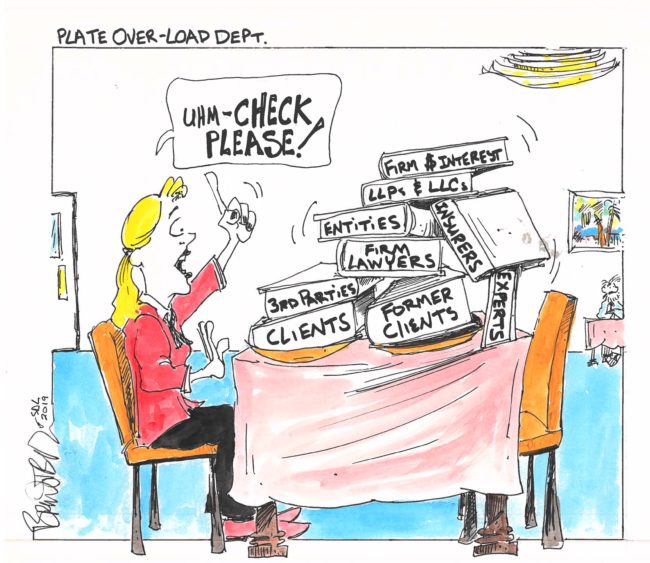
By Edward McIntyre
Sara ushered two young women into Macbeth’s office.
“My friends, Samantha and Fiona, are opening their own firm.”
“Congratulations. A great adventure. Let’s move to the conference table.”
When all were seated, Macbeth asked, “How can we help?”
Fiona started. “We’ve been at large firms. Took things for granted. Now we have to be sure our firm does stuff right.”
Samantha joined. “There’s so much at the start. We’re grateful Sara suggested we meet you.”
“We’re happy to help. Let’s start at the beginning — new clients.”
Fiona laughed. “Best place to start.”
“You’re aware of the new rules?”
Both nodded.
“Let’s look at rule 1.7 — conflicts. It affects every new client. Each new matter.”
Macbeth opened his rules booklet and handed copies to Fiona and Samantha.
“Rule 1.7 (a) doesn’t change much. We can’t represent a client with interests directly adverse to another client without the informed written consent of each. Whether in the same or unrelated matters.”
Macbeth continued. “Now look at 1.7 (b). It requires informed written consent of each client if my responsibility to, or relationship with,” he started to tick the items off on separate fingers, “another client, a former client, a third person — or my own interests — will materially limit my representation of that client.”
Samantha looked up. “I’ve puzzled over that since I first read it.”
Macbeth set his booklet down. “We can talk about examples in a bit. First, how does a lawyer determine whether any such responsibility or relationship even exists? It starts with a practical problem.”
Fiona sighed. “A conflict check system. Something the firm always did. Our general counsel reviewed all new matters.”
Samantha shrugged. “We’re our general counsel now.”
Macbeth smiled. “Precisely. I can’t consider whether responsibility to someone, or a relationship, will materially limit representation of a new client — or a new matter for an existing client — until I identify the responsibilities and relationships each lawyer has.”
“Each lawyer?”
“Yes. If one lawyer has a conflict, it’s imputed to each firm lawyer.”
“Glad we’re only two. We can talk.”
“I suggest setting up your system from the beginning. Then, as you grow, it’ll be there for you.”
Sara added. “And save you from a world of hurt with disabling conflicts.”
Samantha opened a tablet and looked toward Macbeth. “ OK. Conflict check system.”
“Let’s start with the obvious. All current clients.”
Both nodded.
“Then, all clients you represented in the past. At your former firms. I suggest not only corporate, partnership and other entity names, but also fictitious business names. Also names of principal officers, directors and partners. Members of LLPs and LLCs. Then parent and subsidiary corporations — to determine if those relationships create a conflict.”
Fiona and Samantha both took notes.
“Be prepared to pick up corporate and partnership name changes. Entity clients sometimes merge. Get acquired. When you represent individuals, be aware of spouse or partner name changes after marriage or divorce. We also include names of insurers involved in any case.”
Fiona looked up. “Insurers?”
“Remember the tripartite relationship — if you represent an insured based on a contract of insurance, each is a client.”
“Right. Forgot. The firm didn’t do much of that.”
“You may not at your new firm. But I’d have a place for the information — if you do.”
Samantha spoke. “I can see an artificial intelligence-aided system really helping.”
Sara nodded. “ That’s what we have. Interactive. Fully automated.” Read More